

Mark 4:35–41 | Mark 6:45–52
The Sea of Galilee sits in a deep basin surrounded by flat terrain to the north. Winds sweep down fast and without warning. Violent storms can rise and vanish in minutes. Ancient fishermen knew this body of water well, yet its storms still terrified them.
Mark records two of those storms, one in chapter 4 and another in chapter 6. Read them quickly and you might think Mark repeated himself. Both times the disciples board a ship. Both times a storm erupts out of nowhere. Both times Jesus calms it. Both times the disciples end up standing in wide-eyed amazement at His power. They look like identical twins.
But they are not identical. Their DNA is completely different. And the difference matters more than most people realize.
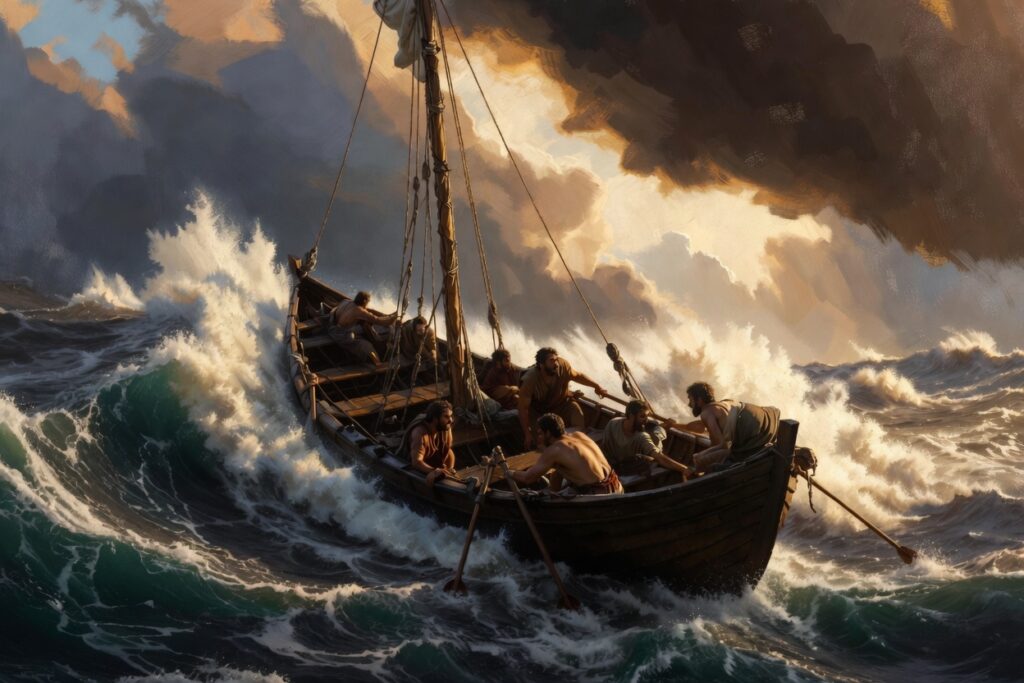
In Mark 4, the disciples are fighting for their lives. Jesus is asleep in the stern on a pillow. They wake Him in a panic: “Master, carest thou not that we perish?” Jesus rises, rebukes the wind, and speaks directly to the sea: “Peace, be still.” The storm obeys His voice and dies.
In Mark 6, it is a completely different story. Jesus comes walking across the water toward the ship. The sea is raging, the wind is tearing at them, the disciples are rowing and toiling and getting nowhere. Jesus steps into the boat, and the storm stops. No rebuke. No word to the wind. No command to the sea. He simply steps aboard, and it ceases.
Why did He rebuke the first storm but say nothing to the second? Because they came from two very different sources.
Before the storm in Mark 4, Jesus had spent hours teaching His disciples about the Kingdom of God: the parable of the sower, the light that must not stay under a bushel, the mustard seed that grows into something great. Then He closed the book and said, “Let us pass over unto the other side.”
The other side meant Gadera. And in Gadera sat a man possessed by a legion of devils, living naked in the tombs, crying out day and night, bound with chains he kept breaking. Jesus was taking His disciples straight toward a divine appointment with that man’s deliverance.
The devil knew they were coming.
So the enemy did what the enemy always does. He sent a storm. A storm violent enough to sink the ship. A storm designed to turn the disciples around, to discourage them, to keep them from reaching that broken man on the other shore.
Mark uses a very specific Greek word to describe what Jesus did next. He rebuked the wind. That same word appears throughout the Gospels when Jesus confronts demons. He rebuked the unclean spirit in the synagogue. He rebuked the foul spirit that drove the possessed boy into fire and water. Here, He rebuked the storm with the same authority He used against the kingdom of darkness, because that storm came from the same source.
It was a storm from hell. And Jesus wrapped it in a garment, gathered it in His fists, and silenced it. Then they went to the other side and did the will of God.
Now look at Mark 6. Just before this storm, Jesus had fed five thousand people with five loaves and two fish. Twelve baskets of fragments left over. An overwhelming, undeniable miracle that the disciples watched with their own eyes.
“For they considered not the miracle of the loaves: for their heart was hardened.”
The miracle should have produced something in them. It should have deepened their trust, broken their self-reliance, and convinced them once and for all that Jesus could handle what they could not. But it did not. The blessing came and went, and their hearts stayed hard.
So Jesus did something remarkable. He sent them ahead in the boat, went up a mountain alone to pray, and watched from the shore as the storm swallowed them. He saw them toiling and rowing and making no progress. And He let it continue until the fourth watch of the night.
That is not a storm from the enemy. That is a Father using adversity to accomplish what miracles and abundance could not.
He never rebuked that storm. He never needed to. When He stepped into the boat, it stopped on its own, because it had finished its purpose.
Here is the truth nobody wants to hear: some storms come from hell, and some storms come from heaven, and you had better learn to tell them apart.
If you cannot tell the difference, you will spend your energy rebuking things God sent to grow you. Or worse, you will quietly endure things the enemy sent to destroy you, calling it patience when God is calling it time to fight.
Some people are standing in the middle of a raging storm, rebuking the devil at the top of their lungs, and nothing is happening. Here is a hard truth: it may not be the devil. God is trying to do something in your heart that good times and miracles never produced, and you keep trying to make it stop. You want the storm gone. God wants you changed.
Others are quietly suffering through winds the enemy sent specifically to push them off course, to keep them from crossing over to their Gadera and delivering what God sent them to deliver. They are treating it like a cross to bear when they should be standing up in the name of Jesus and telling that storm to get out of their way.
Storms are always about the will of God. Sometimes they come from the devil trying to hinder you from the will of God. Sometimes they come from God, trying to press you into the will of God. Just ask Jonah.
That storm was not from the enemy. The great fish was not prepared by the devil. The Bible says the Lord prepared it. Jonah could have rebuked that storm until he was hoarse, and it would not have moved. God sent it to redirect a man running in the wrong direction. The same water as any other sea. Different origin. Different response required.
When you find yourself in a storm, stop before you respond. Ask two honest questions.
First: is this storm trying to block a step God has clearly told me to take? Is it standing against my calling, my purpose, my next season? If so, that storm has the enemy’s fingerprints on it. Stand up, open your mouth, and rebuke it in the name of Jesus. Tell it you are going to the other side.
Second: has this storm come in a season when I have been coasting on blessings without growing? Have I been rowing in my own strength and getting nowhere? Is God trying to show me something my comfort could never teach me? If so, stop rebuking the storm and start surrendering to the purpose inside it.
Think about what the other disciples saw when Jesus came walking on the water. A figure. Moving through the storm. Coming toward them. And their minds went straight to the same place: it is a demon.
That was not an unreasonable conclusion. Two chapters earlier, Jesus had rebuked a storm sent from hell itself. So, I can picture them, in the dark, in the middle of that raging sea, doing exactly what they learned to do the last time: banding together, bracing, beginning to rebuke whatever this was. White knuckles wrapped around the mast. Arms locked around the side of the boat. Holding on for their lives and crying out against the enemy.
But Peter stopped.
Something about this felt different. This did not feel like the last storm. And here is the honest truth about being in the middle of a dark and violent season: it is not always easy to tell what is God and what is the enemy. The darkness is real. The wind is loud. The waves look the same from inside the boat, whether they came from hell or from heaven.
“Lord, if it be thou, bid me come unto thee on the water.”
Is that you, Jesus? That is exactly what we should be asking in the moments when we cannot tell what is happening in our lives. Not just a reflexive rebuke. Not just white-knuckled endurance. A genuine, open question directed at the One who holds the seas in His hands: Is this you?
And when Jesus answered, “It is I; be not afraid,” Peter did not just accept the reassurance and grip the boat tighter. He said something remarkable. Bid me come. If you are trying to do something in my life through this storm, I do not want to stay where I am. I do not want to ride it out from the safety of this boat. I want what this storm has for me.
While the other disciples were holding on, Peter stepped out.
While the others were doing everything in their power to survive the storm unchanged, Peter surrendered to the purpose inside it. And Jesus said, “Come.”
That is the right response to a God-sent storm. Not white knuckles. Not survival mode. Surrender.
If the storm you are in comes from your loving heavenly Father, who loves you enough to lead you through adversity to produce His will in you, then do not waste it. Do not spend it rebuking something God sent. Say, Here I am, Lord. What are you trying to develop in me? I surrender to your will.
And if the storm has the fingerprints of hell on it, if it is trying to stop you from crossing over and doing what God called you to do, then do not sit down and take it. Stand up. Speak to it in the name of Jesus. Tell it: You will not hinder me. You will not get me to quit on the vision, the calling, the destiny God has for my life. I am going to the other side.
Jesus is Lord over both kinds of storms. He gathers the wind in His fists. He wraps the waters in a garment. He spoke, and the Sea of Galilee lay down.
The question is not whether He has power over your storm. The question is whether you know which kind of storm you are standing in.
Get that answer right, and you will know exactly what to do next.
Pastor Matthew Ball serves as lead pastor of Faith Apostolic Church in Carmel, Indiana. This post is adapted from his message “Storms from Heaven and Storms from Hell,” preached June 14, 2026.